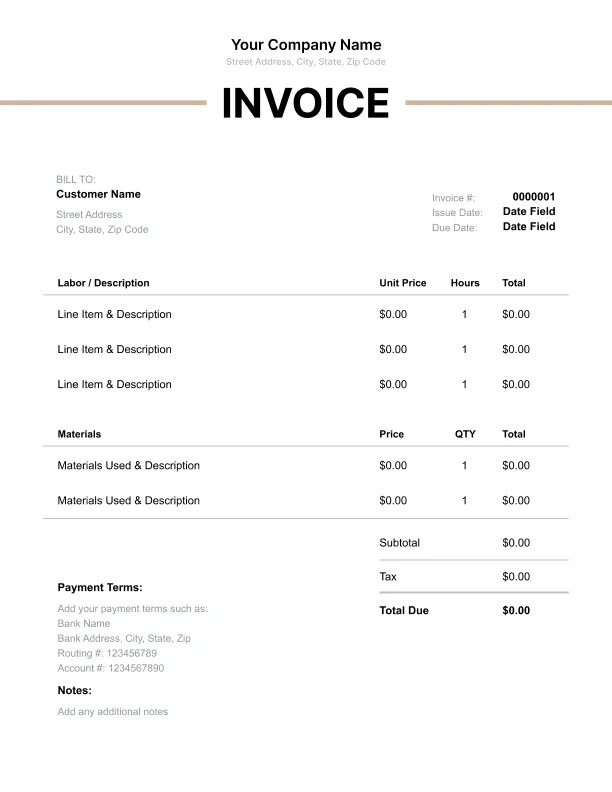
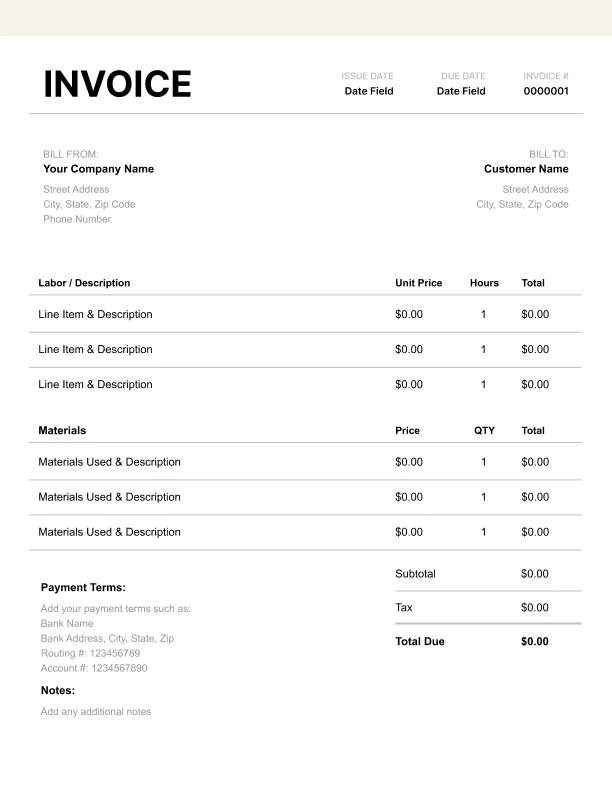
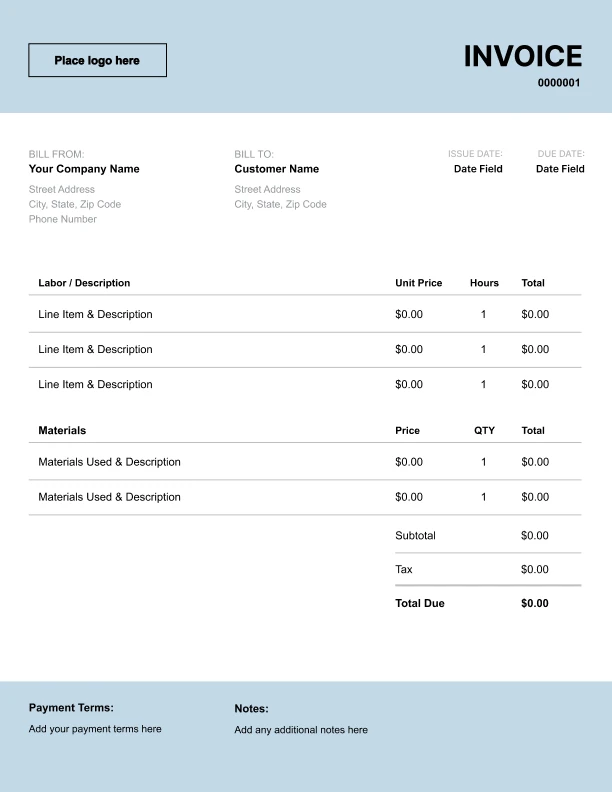
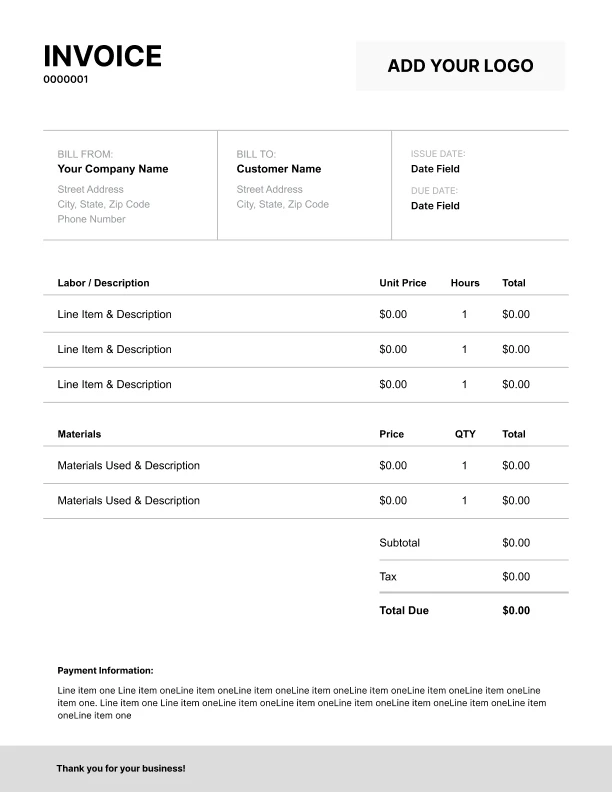
Water Damage Restoration Invoice Template

Free invoice templates for water damage restoration contractors built for water extraction, drying and dehumidification, and cleaning and sanitizing. Download and edit in PDF, Word, Excel, Google Docs, or Google Sheets.

Also called: water cleanup invoice, water cleanup bill, or flood cleanup invoice.

Download Free Water Damage Restoration Invoice Templates

Download a template, then edit in PDF, Word, Excel, Google Docs or Google Sheets. Print or email when ready.

Sheets, Excel, Word and Doc Templates Coming November 21, 2025.

Custom Water Damage Restoration Invoice Template

Best for:
Logo, insurer and RO fields.

Editable Water Damage Restoration Invoice Template

Best for:
Edit rates, equipment days, rebuild lines.

Free Water Damage Restoration Invoice Template

Best for:
Extraction, dehumidifiers, readings, notes.

Printable Water Damage Restoration Invoice Template

Best for:
Totals, claim ref, signatures, photos.

How to Invoice as a Water Damage Restoration Pro

A simple flow from first call to paid, whether it is self-pay or an insurance claim.
Free Online Invoice Generator
☝️ No sign-in. Save as PDF.
In 5 Steps:
  1. Document the loss, set water category and class, and map affected areas with photos.
  2. Build a clear estimate from tasks, labor, equipment, and fees, and collect the deposit or deductible before work starts.
  3. Do the work, track dates, equipment on site, moisture readings, and get signed change orders when scope shifts.
  4. Convert actuals into an itemized invoice, attach logs and photos, list claim details, and apply the deposit to the balance.
  5. Send the invoice with terms, offer easy ways to pay, and note next steps if insurance is paying.
Free Online Invoice Generator
☝️ No sign-in. Save as PDF.

What to Include in a Water Damage Restoration Invoice

These are the must-have fields for clear, compliant invoices.
  • Business legal name, contact info, and logo
  • Contractor license # and IICRC firm #
  • Client name and billing contact
  • Service address and job site
  • Invoice # and invoice date
  • Job # or work order #
  • Insurance details: carrier, claim #, adjuster, and authorization/AOB
  • Payment terms, due date, late-fee policy, and accepted methods
  • Deposit received (date and amount) and balance due
  • Compliance IDs: permit/inspection #, waste manifest #, lead-safe status (check local rules)

Billing Scenarios for Water Damage Restoration Pros

How to label charges so every invoice makes sense the moment your clients see it.

1.
Emergency call-out fee; After-hours surcharge
Emergency response after normal hours
Signals urgent mobilization and the premium for work outside normal hours.
2.
Water extraction labor; Extraction equipment rental
Standing water removal
Covers crew time and the tools used to pull water fast.
3.
Dehumidifier rental (per day); Air mover rental (per day)
Multi-day structural drying
Shows daily rates and quantity so the drying window is clear.
4.
Monitoring labor; Moisture readings report
Daily site visit to monitor drying
Add the carrier, claim number, adjuster contact, and a note that you are authorized to bill the insurer. Confirm any deductible owed by the client.
5.
Sewage cleanup (Category 3); Waste handling and disposal
Sewage or black water contamination
Includes higher-risk work and compliant disposal.
6.
Pack-out and inventory; Storage (per day)
Separates moving items out from storing them off-site.
Free Invoice Generator
No sign-in. Save as PDF.
Create a Free Account
☝️ Risk-free 30-day trial.

Common charges and equipment time for water damage restoration

Itemize extraction, drying, dehumidification, cleaning, sanitizing, and equipment by day with professional invoice line items.

Charge or Service
Unit
Taxable
When to use
How to show it
Emergency Extraction
Time
Standing water present
Hours × hourly rate. Use pumps and wands; document start/stop times and affected areas for your drying log.
Moisture Inspection & Mapping
Time
After initial walk-through
Hours × hourly rate. Include meter/IR readings and create a sketch to guide equipment counts and drying goals.
Structural Drying Setup
Time
Before placing equipment
Hours × hourly rate. Includes pulling base, drilling weep holes, and setting targets per S500.
Air Mover Rental (per day)
Item
Drying porous materials
Qty × days × daily rate. Size per cubic feet and class of loss; record serials on your equipment log.
Dehumidifier Rental (per day)
Item
Controlling humidity
Qty × days × daily rate. Choose LGR/desiccant capacity to hit grains-per-pound targets; monitor daily.
Containment Barrier Install
Item
Isolating work zones
Qty × unit rate. Includes poly, zippers, and tape; remove cleanly and dispose per local rules.
Antimicrobial Application
Item
After extraction/demolition
Qty × unit rate. Apply labeled product to affected surfaces; note dwell time and product lot in job file.
Content Pack-Out & Storage
Time
Moving at-risk contents
Hours × hourly rate. Inventory, box, and photo contents; track storage days as pass-through or per-day charges.
After-Hours Emergency Call-Out
Item
Nights, weekends, holidays
1 × call-out rate. Covers premium mobilization outside normal hours; log arrival time and crew size.
Baseboard/Trim Replacement Materials
Item
Taxable
Materials damaged by water
Qty × cost × (1 + markup%). Materials retained by customer; labor billed separately under Time.
Save and reuse your water damage rates and equipment
Create a free account and save extraction, drying, and equipment rates once, so nothing gets retyped.
Create a Free Account
☝️ Risk-free 30-day trial. No card.

Common Water Damage Restoration Invoicing Mistakes

Water jobs move fast and get messy on paper. Use these fixes to keep bills clean and prevent disputes.

Mistake
How to fix it
Not stating the water category and class, which leads to scope disputes.
Quote the category and class on the invoice header and summarize affected rooms. Reference the scope so everyone sees the same plan.
Leaving out start and end dates for time-based charges, which triggers pushback.
Show the calendar dates for each charge that accrues by day. Include pickup or completion dates so the timeline is transparent.
Attach drying logs with room readings and a short summary of when targets were met. Keep the raw data available on request.
Add the carrier, claim number, adjuster contact, and a note that you are authorized to bill the insurer. Confirm any deductible owed by the client.
Not showing the deposit received or how it was applied, causing balance confusion.
Record the deposit as a receipt and subtract it on the final invoice with the date and reference number. Show the remaining balance due.
Using one vague line for a complex job, which shocks the client.
Break the bill into separate lines for labor, materials, equipment, fees, and disposal. Use plain language that matches the work order.

Water Damage Restoration Invoice FAQs

Bill extraction, daily equipment, sewage cleanup surcharges, pack-out storage, and deductibles the right way with our Water Damage Restoration Invoice Template for clear answers.

How should I bill an after-hours emergency extraction call?

List an after-hours mobilization fee plus labor and a minimum. Example: “Emergency response 10pm–1am: After-hours mobilization $250; Water extraction 3 hrs @ $85/hr; Minimum service charge $150.”

What counts as a daily equipment charge?

Charge per unit, per day, until dry standards are met. Example: “Air movers 12 units x 3 days @ $25/day; LGR dehumidifiers 3 units x 3 days @ $55/day; HEPA air scrubber 1 unit x 3 days @ $65/day.”

Can I bill for daily monitoring visits?

Yes. Include each trip with moisture readings. Example: “Moisture monitoring 4 visits @ $45/visit; Moisture map & photos $60.”

How do I price sewage or Category 3 water jobs?

Add contamination surcharges, PPE, and special disposal. Example: “Category 3 cleanup surcharge $300; PPE kit 4 sets @ $25; Bio-waste disposal 6 bags @ $18; Disinfectant application 2 gal @ $32/gal.”

How should I bill pack-out, storage, and contents cleaning?

Split labor, materials, and storage days. Example: “Contents pack-out 6 labor hrs @ $70/hr; Boxes & wrap $85; Storage 120 cu ft x 14 days @ $0.80/cuft/day; Contents cleaning 8 items @ $25.”

Does reconstruction go on the same invoice as mitigation?

Keep mitigation and rebuild separate. A restoration contractor typically issues two bills. Example: “Mitigation total $3,450” and a separate “Reconstruction estimate: drywall install 240 sq ft @ $2.50/sq ft.”

How do I show the homeowner deductible and insurer payment on the invoice?

Show full job total, subtract the deductible, and note anticipated insurance funds. Example: “Job total $6,200; Less deductible $1,000; Prior insurer payment (ACV) $3,500; Balance due from customer $1,700.”

Do I need to list permits, testing, or third-party hygienist fees?

List any required tests or permits when materials are disturbed. Rules vary—check local rules. Example: “Asbestos sampling 3 samples @ $45; Lead test 2 units @ $35; Hygienist clearance $250.”